There are people in the immersive industry who say every escape room needs multiple rooms. But is that really true?
I’m challenging the idea that multiple rooms equals a better experience. As escape room designers, we should be aiming to break rules and create new and exciting immersive attractions. Multiple rooms should be the least of our concerns.
A single room escape room can be just as immersive, challenging and memorable as a multi-room game by using what I call the “illusion of extra space”. My past life as a full-time magician taught me that your physical space should never be a hindrance to the world you’re pulling your players into.
Immersion Isn’t Defined by Size
Let’s start with an issue I’ve noticed in some of the multi-room games I’ve played: thematic cohesion.
I’m not saying multi-room escape rooms shouldn’t exist. A restaurant-themed escape room, for instance, makes sense with a kitchen. It would be weird if that was an open-plan kitchen… unless it’s a sushi restaurant. I’m digressing. The point is, a room like that has natural cohesion between its spaces. If you’re hunting for a stolen recipe, of course you need to get into the kitchen. It doesn’t feel like a room was added just because the game needed another room.
Where cohesion becomes a problem for me is when an extra room has no explanation, either for why it’s there or how you get into it. I don’t want to crawl through another fireplace to find an office. Who on earth has an office where the only entrance is a crawl space?!
It may just be me, but I start to lose focus on the rest of the game while I grapple with what I’ve just done. The narrative slips away from me, and it ruins the immersion.
Keeping your narrative and atmosphere controlled works best when every area of your room makes sense, and when more focus goes on puzzle and story design than on space design. Extra rooms aren’t a necessity, so real thought needs to go into them.
Puzzles and Atmosphere Over Layout
I’ve already explained how I feel about this, but it’s worth digging a little deeper. Comic Chaos, our third escape room, is a good example of what I mean.
I’m hellbent on reinterpreting the same space! Some of the best “aha” and “wow” moments in my rooms come from using a space twice, in a new and fresh way. I can already feel some enthusiasts and owners boiling over at that statement… but it’s absolutely OK.
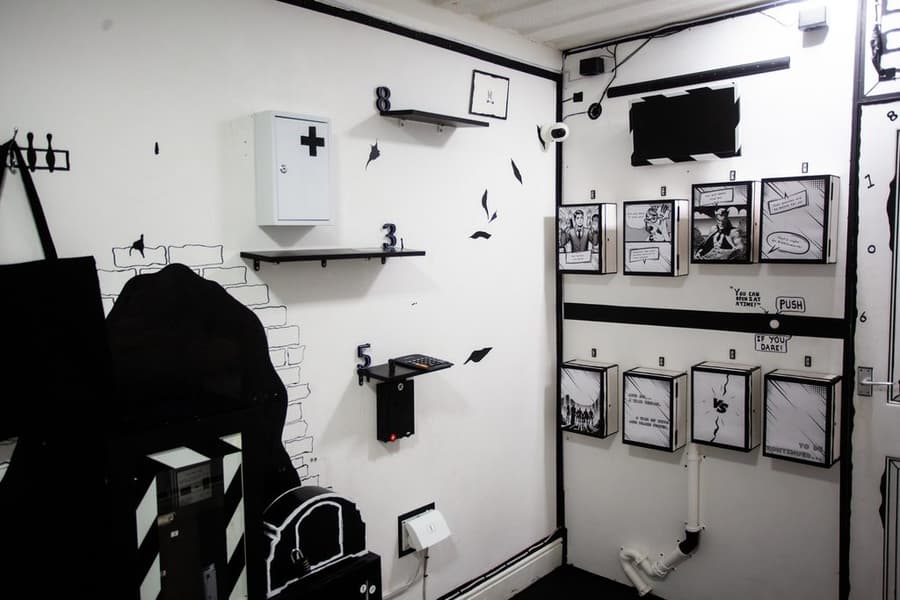
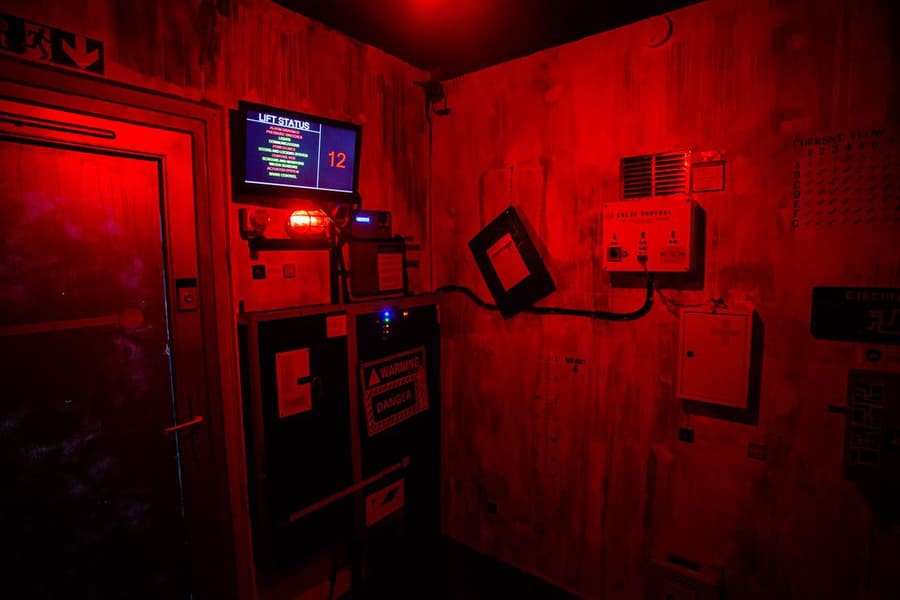
The idea that puzzles should be as far apart from each other as possible only limits what you can do with the space you have. Comic Chaos and The Lift Shaft are perfect examples of reinterpreting and reusing space. Parts of the room change or open up multiple times, in multiple places, or the feel and atmosphere of the entire room shifts. That’s what creates the illusion of extra space.
Connected, well thought out puzzles can thrive in a small space or a single-room game.
Pacing and Flow: When Extra Rooms Slow the Game Down
As I mentioned earlier, crawling through a tunnel into a fancy office or an unfitting room doesn’t just make no sense to me; the transition also feels clunky. I’ve lost time crawling, and the wow factor disappears. (To be fair, some people love crawling around. My annoyance is purely personal!)
Not all rooms have clunky transitions. A simple door opening into another room doesn’t affect the flow of a game. But I’ve definitely experienced new room reveals that slow everything down, sometimes straight after an adrenaline-filled puzzle solve, and that energy is lost while you wait for the new room to become accessible. I can already hear you shouting “but that’s just bad game design!” and you’d be right. But could it also be that the new room is the restriction?
I’ve also had countless conversations with players who were happy they didn’t have to move between multiple rooms. Almost every time, it came down to one of three things:
- Losing engagement with your team. Single-room games keep players together and focused on the game, which boosts teamwork and engagement.
- The flow of the game becoming convoluted. This is especially true of games with extra spaces for the sake of having them. Keep things making sense. The Lift Shaft wouldn’t work with a large room attached to it; it would be unrealistic and break the immersion.
- The extra room feeling less about the puzzles and more about “look what I built”. We all take pride in our work as escape room owners, but sometimes that pride overshadows puzzle design, and players notice it far more than you might think.
I’ve felt all three of these myself as a player, and none of them help create an experience everyone enjoys.

Accessibility and Safety in Single Room Escape Rooms
Accessibility and safety don’t get mentioned nearly enough, and they’re important.
Most escape rooms I’ve played aren’t fully accessible, usually because they’re up or down flights of stairs or tucked away in weird and wonderful places. But we should all do our best to accommodate as many players as we can.
Without crawl spaces, stairs or ladders between rooms, we’ve been able to welcome more players than we otherwise could. Single rooms have made our games accessible to more people, and that means more people enjoying the escape room experience.
Safety, for our players and our staff, is also much easier to monitor in a single room. We’re lucky never to have had an emergency in our escape rooms, but if we did, our plans for dealing with it are simpler and more streamlined, and single rooms are what make that possible.
I’m a firm believer that constraint breeds creativity. Letting yourself be constrained forces you to look at the creative process differently: how can we create an awesome immersive experience in this space? It makes us think about depth rather than breadth, and to focus on areas we might otherwise overlook.
Players Remember the Experience, Not the Square Footage
In the end, I want my players to leave having had a great experience: brilliant puzzles inside an awesome story that plucked them out of the mundane and into the incredible.
It’s not about how many rooms you have; it’s about how good your experience is. Encourage your players to judge your games by their creativity, immersion and fun, not their floor plan.
If you enjoyed this, you might also like What Makes an Escape Room Truly Unique? Or come and see the illusion of extra space for yourself: book a game at The Lift in Brighton.